

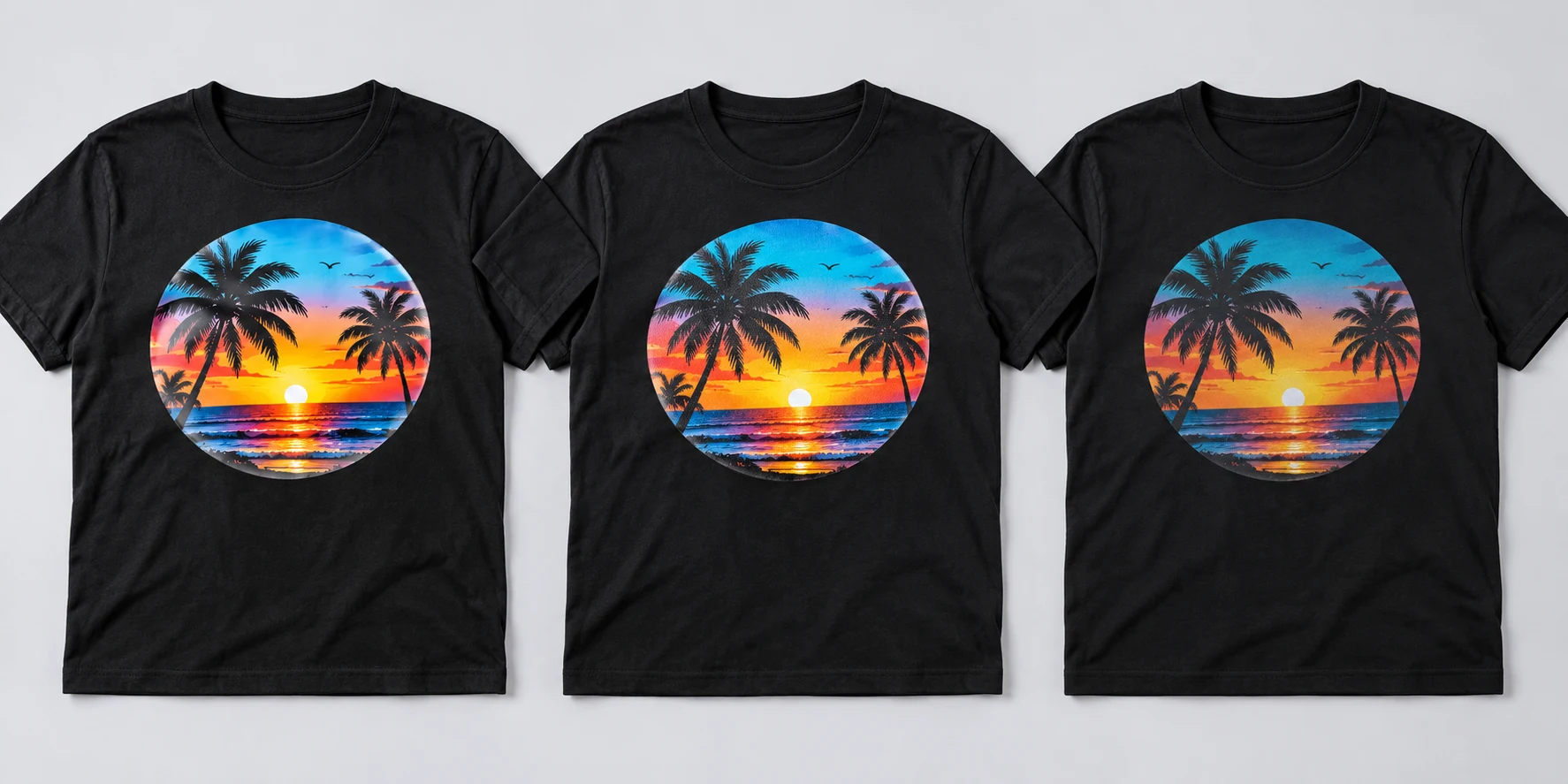
DTF, screen printing and DTG all put a design on a shirt, but they bill you in very different ways. Screen printing charges you up front for screens and then gets very cheap per piece. DTF and DTG need no setup, so the first shirt costs about the same as the fiftieth.
Choose DTF for small and mixed runs on almost any fabric, screen printing for several hundred identical pieces in a few solid colours, and DTG for soft, photo-quality one-offs on cotton.
This comparison is written for people who decorate garments themselves or order them for a club, a brand or a company. You’ll see what each method costs at realistic quantities, how the print feels and washes, and where each one fails.
DTF, screen printing and DTG at a glance
| Criterion | DTF | Screen printing | DTG |
|---|---|---|---|
| How the design gets on the garment | Printed on film, then heat pressed | Ink pushed through one mesh screen per colour | Inkjet prints straight onto the fabric |
| Setup before the first print | None | One screen per colour and print position | None, but dark garments need pretreatment |
| Sweet spot for quantity | 1 to roughly 100 to 200 pieces, plus any mixed order | Several hundred identical pieces and more | 1 to a few dozen pieces |
| Photos, gradients, many colours | Yes, at no extra cost | Possible, but every colour adds a screen | Yes, at no extra cost |
| Cotton | Yes | Yes | Yes, its best fabric |
| Polyester and sportswear | Yes, with a Blockout version for dyed polyester | Yes, with inks made to resist dye migration | Limited, needs special pretreatment |
| Dark garments | Yes, the white underbase is built in | Yes, with an underbase | Yes, after pretreatment |
| Hand feel | Thin, flexible layer on the surface | Soft (water-based) to noticeable (plastisol) | Softest, the ink sits in the fibres |
| Can be printed ahead and stored | Yes, as transfers | No | No |
| Neon, metallic, exact spot colours | No (CMYK plus white) | Yes | No |
A table can’t see your fabric. Before a larger order, press or print one sample on the exact garment you plan to use.
What is the difference between DTF, screen printing and DTG?
The difference lies in where the ink goes first: onto a film (DTF), through a stencil (screen printing) or straight onto the fabric (DTG). Everything else, from cost to feel, follows from that.
A DTF printer lays the design onto a carrier film in CMYK, backs it with a white layer and coats it with hot-melt adhesive. A heat press then bonds the print to the textile. Because the print exists as a finished transfer, printing and pressing can happen at different times and in different places.
Our DTF printing guide covers the process, file setup and care in full (in German).
Each colour in the design is separated and gets its own mesh screen. A squeegee pushes ink through the open areas of the screen onto the garment, one colour after another. Making and registering the screens takes time. Once that’s done, the press runs fast and every further shirt costs very little.
DTG works like an inkjet printer for clothing. Water-based ink goes directly onto the shirt and is then cured with heat. Dark garments first receive a pretreatment liquid and a white base layer so the colours stay opaque. The method gives its best results on cotton.
Which method is cheapest at 10, 50 and 500 pieces?
DTF or DTG wins at 10 pieces, DTF usually still wins at 50 multicolour pieces, and screen printing wins at 500. The reason is the split between fixed and running costs.
Screen printing has a fixed cost before the first shirt. US suppliers quote anywhere from about $15 to $60 per screen, and Gelato, for example, cites $30 to $40. You need one screen per colour and per print position, so a four-colour front with a one-colour back means five screens. Spread over 20 shirts, that setup dominates the price. Spread over 500, it almost disappears, and the ink for each shirt costs cents. German print shops set their own prices, so ask for a quote with your exact colour count.
Schematic, not real quotes: it shows the shape of the cost curves, not exact prices.
Where is the break-even? Published figures range from about 25 pieces for a simple one-colour logo to 100 or 150 pieces for multicolour work. The spread exists because every extra colour pushes the break-even higher. We use 100 to 200 pieces as a rule of thumb and explain the reasoning in our head-to-head look at DTF and screen printing.
DTG has no setup either. Ink and pretreatment make each print comparatively expensive, though, and the price barely falls as the quantity rises. That makes DTG a method for one-offs and very short runs.
What a DTF print costs: a worked example
DTF pricing follows the film area you use. The number of colours and the number of motifs don’t matter. Our running metre measures 570 × 1000 mm and costs €18.90 including VAT, falling to €15.90 from 25 metres. With a 5 mm gap between motifs, one metre holds:
| Motif | Fits on one metre | Film cost per print at €18.90 | At €15.90 (25+ metres) |
|---|---|---|---|
| Left-chest logo, 90 × 90 mm | 60 | €0.32 | €0.27 |
| Medium motif, 180 × 180 mm | 15 | €1.26 | €1.06 |
| Front print, 280 × 300 mm | 6 | €3.15 | €2.65 |
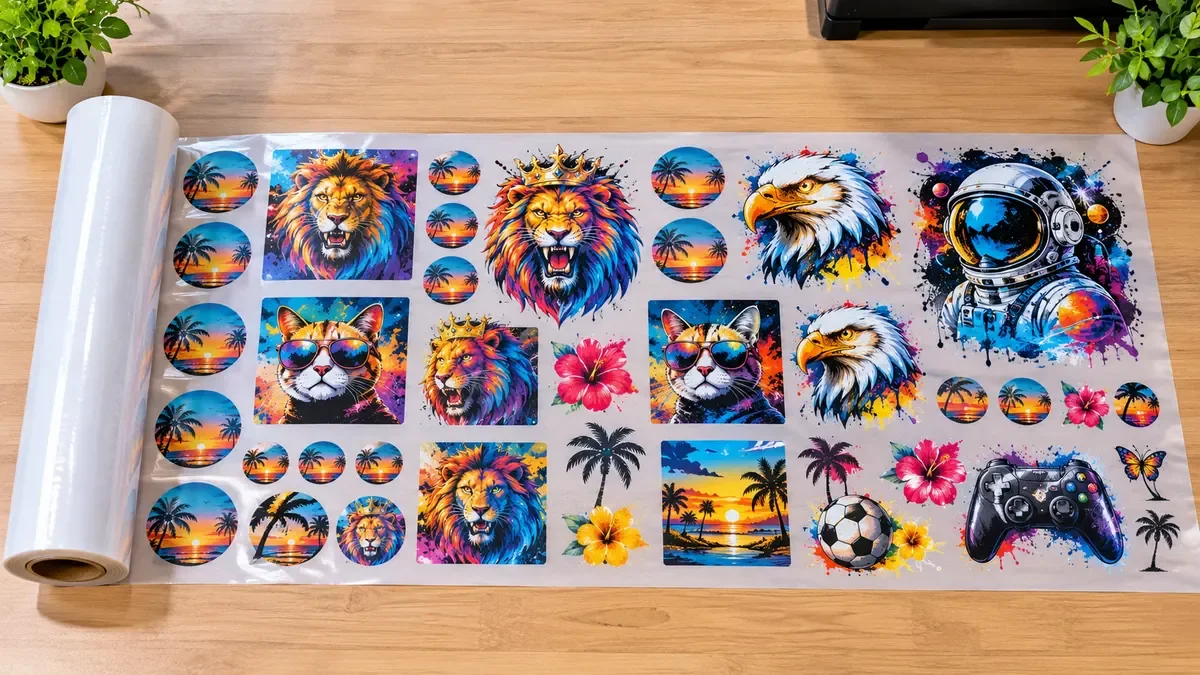
These figures are plain arithmetic from our list prices. Add €6.99 shipping per order, your blank garment and your time at the press. If you plan to gang several motifs, you can order by the running metre. For single motifs, A4 and A3 sheets start at €5.50 and €8.50.
Order DTF transfers
Want to see the numbers on your own garment? Pick a format and quantity below and upload your design:

Which print lasts longest in the wash?
Properly cured plastisol screen prints have the longest track record, and correctly pressed DTF transfers hold up through many washes too. DTG depends most on pretreatment and curing, which is why reports about it differ so much.
Be careful with wash-count claims. Published numbers for DTG run from about 20 washes to more than 50, and for DTF from 40 to 60 and beyond. Each figure reflects one supplier’s inks, fabric and test conditions, so compare them with caution.
For our transfers, the care rules are simple:
- Wait 24 hours after pressing before the first wash.
- Wash the garment inside out.
- Up to 60 °C is possible. 30 to 40 °C is gentler on print and fabric.
- Skip the fabric softener.
- Never iron directly on the print.
When a DTF print does peel, the cause usually sits at the press rather than in the washing machine: too little pressure or too short a press time.
How does each print feel on the shirt?
DTG feels softest on cotton because the ink soaks into the fibres. On a white shirt you can barely feel it.
Screen printing depends on the ink. Water-based inks stay soft. Plastisol forms a layer you can feel, which many people associate with a classic band shirt.
DTF sits on top of the fabric as a thin, elastic layer. On a chest logo or a medium motif you’ll hardly notice it. A solid A3 block is a different story, because a closed surface that size lets less air through.
Design around it: Leave the shirt colour visible inside the motif with transparent areas instead of filled backgrounds. Pressing a second time under baking paper also improves the feel and the wash resistance.
Which fabrics and garment colours work with each method?
A cotton method. On dark garments, pretreatment is essential for a durable white base, according to trade magazine Digital Output. Polyester needs its own pretreatment and careful curing, and Lawson’s guide to Epson’s polyester pretreatment warns that results vary with the dyes in each garment.
Handles nearly any fabric as long as the shop picks the right ink system. Polyester calls for inks formulated to resist dye migration.
Covers the widest range with a single product: cotton, polyester, blends, nylon, canvas and felt, on light and dark garments alike. For sensitive materials such as nylon or softshell, lower the press temperature.
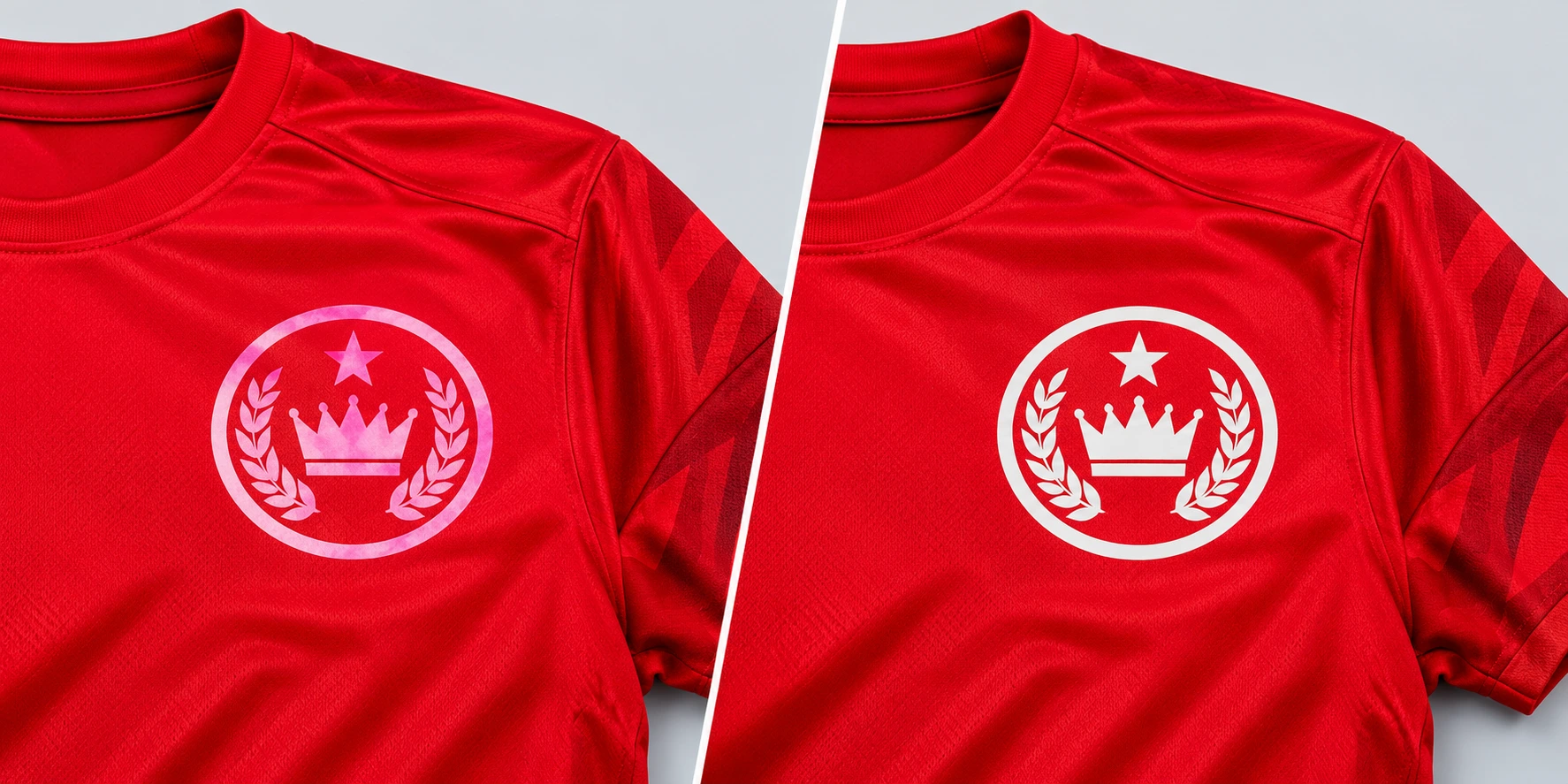
Dyed polyester is the one case that needs extra thought. Under heat, the dye in a red jersey can creep into the white areas of a print and turn them pink hours later. Blockout DTF transfers for dyed polyester add a barrier layer between adhesive and white underbase and press at 120 to 130 °C for 12 seconds. The barrier reduces dye migration significantly but can’t rule it out in every case. Press one test piece from the same textile batch and check it after 24 hours.
DTF doesn’t suit waterproof, impregnated or silicone-coated textiles, because the coating stops the adhesive from bonding.
Which method handles photos, gradients and fine detail best?
DTF and DTG. Both print digitally in full colour, so a photo costs the same as a one-colour logo. Screen printing can reproduce photos through halftones, but each added colour means another screen and more setup.
Screen printing wins a different contest: exact spot colours, neon, metallic and other special-effect inks. A CMYK process can’t reproduce a neon yellow or a true metallic silver. If your brand manual prescribes a specific Pantone on 1,000 shirts, screen printing is the safer choice.
For clean DTF results, prepare your file like this:
- 300 dpi at the final print size
- Transparent background (PNG or PDF), otherwise you get a white box
- CMYK colour mode, since RGB files often print paler
- Fonts converted to outlines
- Lines at least 0.4 mm thick
- Don’t mirror the file. We do that for you.
How does the workflow differ?
This is the point most comparisons skip. With screen printing and DTG, you receive finished garments from a print shop and must commit to sizes and quantities up front. Guess wrong, and you’re left with ten unsold XS shirts.
DTF separates printing from decorating. You order transfers, keep blank garments on the shelf and press on demand, once you know who needs which size. The same transfer goes onto a T-shirt today and a hoodie or tote bag next week.
The price for that freedom is a heat press and a minute of your time per piece. The process for our standard transfers:
Pre-press the garment for about 3 seconds to remove moisture and creases.
Press the transfer at 120 to 150 °C for 10 to 15 seconds with medium pressure.
Peel the film while it’s hot (hot peel).
Cover with baking paper and press again for 5 to 10 seconds.
Which method should you choose?
Match the method to the job in front of you:
| Your job | Best method |
|---|---|
| 15 club hoodies with a full-colour crest, names to follow later | DTF |
| 800 one-colour event shirts | Screen printing |
| One photo shirt as a gift, on cotton, and you own no heat press | DTG from a print shop |
| Polyester team jerseys with sponsor logos and numbers | Blockout DTF |
| A merch brand testing five designs | DTF, stock the transfers and press to order |
| Corporate wear in an exact brand colour or with metallic ink | Screen printing |
| Left-chest logos across polos, softshell jackets and caps | DTF, with a lower temperature on the softshell |
Can you combine methods? Yes, and many shops do. Run the large core order through screen printing, then use DTF for names, numbers, sponsor changes and late reorders that would never justify new screens.
Ready to test DTF on your own garment? Upload your design, choose A4, A3 or the running metre, and we’ll print your DTF transfers in Bitterfeld-Wolfen. Delivery takes 3 to 5 working days after print approval, shipped with DPD within Germany.
Frequently asked questions
Is DTF better than DTG?
It depends on the fabric and how you work. DTF adheres to cotton, polyester and blends, can be stored as a transfer and costs little for small logos. DTG feels softer on cotton because the ink sits in the fibres, but it needs pretreatment on dark garments and struggles on polyester.
Is DTF cheaper than screen printing?
For small runs and multicolour designs, yes, because DTF has no setup cost. Screen printing becomes cheaper once several hundred identical pieces with few colours share the cost of the screens. As a rule of thumb, the two meet somewhere between 100 and 200 pieces.
Does DTF crack or peel after washing?
A correctly pressed DTF transfer stays flexible and doesn’t crack. Peeling usually traces back to too little pressure or too short a press time. Wait 24 hours before the first wash, wash inside out at 30 to 40 °C and avoid fabric softener.
Can I apply DTF transfers with a household iron?
We recommend a heat press. The transfer needs 120 to 150 °C under even, medium pressure for 10 to 15 seconds, and a household iron can’t hold either value reliably across the whole motif.
Is there a minimum order for DTF transfers?
Our price list starts at a single A4 sheet, A3 sheet or running metre. From 5 identical items, a quantity discount applies automatically in the cart.
A4, A3 or running metre, printed in Bitterfeld-Wolfen and shipped with DPD within Germany in 3 to 5 working days after print approval.
Order DTF transfers now